It is tempting for Directors in an organisation to make executive decisions and drive change individually and autocratically. This may be well- intentioned and even based on sound reasoning. However, both theory and practice indicate that such actions are likely to be doomed. In his extensive research on what makes change either work or fail, change research specialist John Kotter highlights the importance of both having a clear vision for the change, and then creating a coalition around this vision.
Coalition is a strong word, often used in a political context, implying union of individuals and groups into a critical mass, heading towards a shared objective. In organisational changes I have seen, failure to identify and engage key stakeholders to form a coalition in early stages, inevitably results in corridor talk, misperceptions, emotions, and inevitably “resistance” that derails the changes.
Why Coalitions Matter More than Authority
Kotter’s 1996 research gives important guidelines for creating coalitions. An effective coalition requires four qualities: position power sufficient to prevent blockers from derailing the effort, expertise relevant to the change, credibility that commands respect from the broader organisation, and leadership capacity to drive the process forward.
In a 2013 Harvard Business Review, researchers Battilana and Casciaro added an important component to creating a change coalition. They spoke of the importance of the “network position” of change agents, which matters more than their formal authority. People in network positions are those who can bridge gaps and divides, capable of connecting otherwise disconnected groups. Such people are hugely effective in driving change.
This research indicates that the most powerful coalitions include not only senior leaders but well-connected individuals at multiple organisational levels who can translate the change vision across boundaries. The seemingly humble person who links the finance team to operations, or the respected ward nurse who connects clinical staff to administration, are bridge-builders, ultimately determining whether change goes ahead successfully or not.
What Coalitions Are Not
A coalition is not a steering committee that meets fortnightly and reviews dashboards. It is not a project team following terms of reference. It is a committed group that has done its own emotional work around the change, whose members trust one another enough for difficult conversations, and who collectively represent sufficient organisational influence to create critical mass.
In my Gestalt work with groups, I pay attention to the quality of contact between coalition members. Are they present with each other, or performing collaboration? Can they disagree openly, or does the group default to false consensus? A coalition that cannot hold tension internally will collapse at the first sign of organisational pushback.
The trust dimension is critical and frequently underestimated. Coalition members need to trust one another enough to admit uncertainty, share bad news early, and challenge each other’s assumptions. Building this trust takes time and facilitated dialogue — it cannot be shortcut by a team-building offsite or a personality profiling exercise.
Reading the Political Landscape
In hierarchical organisations like government departments, coalitions need explicit endorsement from the top. In more networked environments like universities, coalitions require broad representation, engagement and buy-in. In Thornhill Associates’ consulting work across sectors, we have observed that the ability to read the political landscape of an organisation and build coalitions is an important and underrated skill in change leadership.
A Practical Test
Here is a helpful activity to do in a change process. List the eight to 12 people whose support will determine whether your change initiative succeeds. (It can also be helpful to consider who may most oppose the change initiative…) It is then useful to ask, how many of them are currently in your coalition? How many are in formal leadership positions versus informal influence roles? Who is missing, and what does that tell you?
If the coalition looks like a subset of the executive committee, it is probably too narrow. If it includes only people who already agree with the direction, it is definitely too narrow. The strongest coalitions include at least one or two respected sceptics whose presence signals to the broader organisation that this change has been properly interrogated, not just mandated.
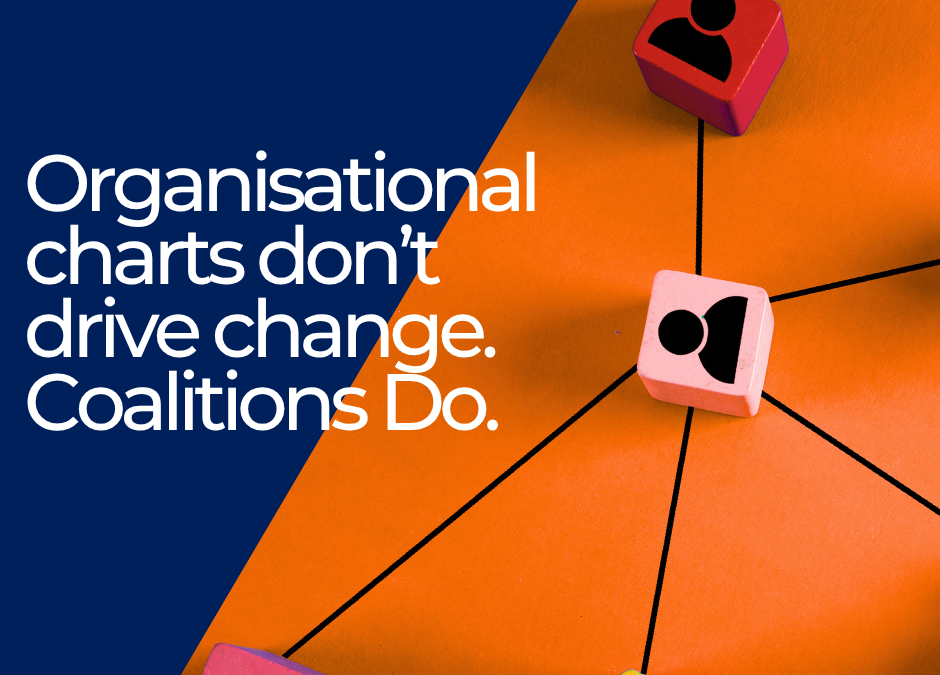
The organisational chart tells you who reports to whom. The coalition tells you who can actually move an organisation.
If your organisation is navigating complex change, leadership transitions, or stakeholder resistance, Thornhill Associates can help you build the coalitions that turn strategy into sustainable action. Connect with the team to explore leadership development, organisational consulting, and change facilitation tailored to your context.